
What is cross-country paragliding?
There’s a particular kind of silence in cross-country paragliding that stands apart. it’s not merely the absence of noise, but the presence of stillness — the quiet that surrounds a wing in flight, high above the landscape, suspended between layers of air, between decision and discovery. it is in this space that cross-country paragliding unfolds: not just as a sport, but as a form of exploration.
Cross-country flying, often referred to simply as “XC,” is not about airtime for its own sake. it is about distance, navigation, and understanding the sky. it is about setting out with purpose — from a mountain, a ridge, or a hill — and seeing how far one can go using nothing but the energy of the atmosphere and the skill of the pilot.
At its core, cross-country paragliding is the practice of flying from one point to another, usually covering significant distances, using natural lift sources such as thermals, ridge lift, valley winds, and convergence. unlike local soaring, which remains close to the launch site, XC flights move across terrain — past unfamiliar ridges, across valleys, over towns and forests — toward a goal, or simply into the open.
The defining characteristic is forward movement. whether aiming for a declared goal, attempting a circuit like an out-and-return or a triangle, or flying as far as conditions allow, XC flying is always about exploration — across unfamiliar terrain, through changing air masses, and into the evolving challenges of each decision made aloft.
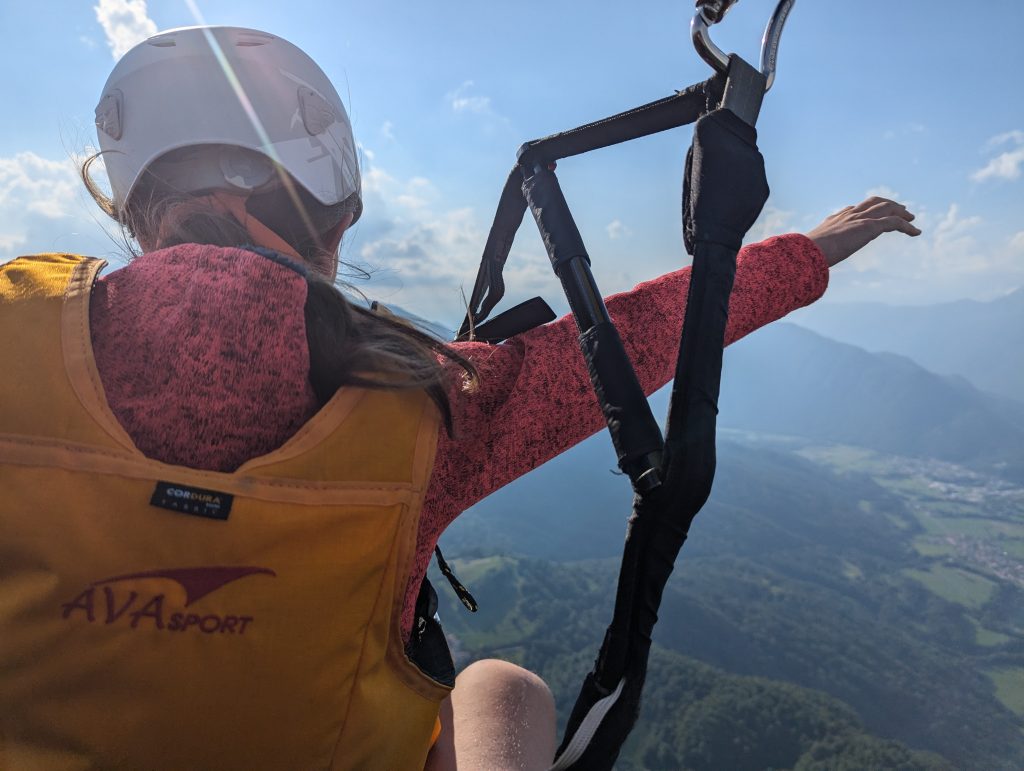


The structure of an XC flight
A cross-country flight unfolds through a continuous interaction with the atmosphere — a dynamic mix of climbing, gliding, terrain reading, and in-flight decision-making. while thermals are the most familiar form of lift, they are only part of the picture. XC flying draws on a variety of lift sources, terrain interactions, and atmospheric effects that all contribute to sustained flight.
Climbing: thermals and more
Thermals — columns of rising air triggered by uneven heating of the ground — remain the backbone of XC flight. pilots circle in these invisible elevators, gaining thousands of meters of altitude at times, reading subtle signs on the landscape and in the air.
But cross-country flying also taps into other forms of lift:
- dynamic lift: wind striking terrain can create smooth, predictable lift along ridges and slopes. this ridge lift is often used to maintain or gain height while moving along a line of terrain.
- valley winds: in mountainous areas, as the sun heats the slopes and summits, large volumes of warm air rise, drawing cooler air up through the valleys. these valley wind systems can produce consistent upslope flow and usable buoyant air, especially in the afternoon hours.
- convergence: where two air masses meet — for example, valley winds and prevailing wind from different directions — a convergence line may form. these zones can provide long corridors of lift, often marked by cloud streets or distinct changes in air texture.
Experienced XC pilots learn to work all these layers of the atmosphere. each climb is not just a thermal — it might be a bubble kicked off a forest edge, a late-day convergence pulse, or a band of lift above a sunlit ridge. the key is knowing what the air is doing and why.
Gliding: connecting the dots
The glide between lift sources is where much of the distance is covered — and where many flights end. but gliding isn’t simply descending; it’s active, strategic movement through the airmass.
Good pilots seek energy lines — paths where lift outweighs sink, sometimes invisible, sometimes hinted at by clouds, terrain features, or the movement of other pilots. these glides are not passive; they’re filled with constant recalculations: should i stay along this ridge? is that cloud decaying or building? is the valley wind helping or hurting?
During the glide, the pilot evaluates every option: when to push on, when to slow down, and when to veer off-course for better terrain or better odds. efficiency in gliding often separates the solid XC pilots from the great ones.


Decisions: the true core of XC
More than climbing or gliding, cross-country flying is about decision-making. it’s a constant stream of judgment calls — some minor, some critical — all stacked one atop the other. when to leave a thermal. whether to dive into a blue hole or hold a line toward developing clouds. whether to push into wind or retreat to safer terrain.
These decisions aren’t about gambling. they’re about stacking the odds — based on experience, observation, and gut feel honed over time. the best XC pilots aren’t reckless. they are thoughtful, adaptable, and patient. they know that progress sometimes means holding back — and that the sky rewards those who read it with care.
Equipment for cross-country flight
While the fundamentals of paragliding equipment remain the same — wing, harness, reserve, helmet — XC flying places greater demands on gear in terms of performance, efficiency, and comfort.
- wing: XC pilots often fly wings that balance performance and safety, ranging from high EN-Bs to EN-Ds. glide efficiency, speed, and thermal handling become critical over longer distances.
- harness: most XC pilots fly pod-style harnesses for their improved aerodynamics and added comfort over many hours. they also offer more space for instruments, hydration, and survival gear.
- instruments: a variometer with GPS is almost standard. it gives climb/sink rates, altitude, glide ratio, and route navigation. more advanced models include thermal mapping, airspace warnings, and live tracking.
- safety and tracking: many XC pilots carry satellite trackers or use mobile tracking apps — not just for retrieval, but for added safety in remote areas.
- essentials: high-altitude clothing, gloves, energy food, water, a phone, and land-out kit — all are packed with the expectation that the flight may end far from where it began.
That said, it’s worth noting that some very experienced pilots prefer to fly with the bare essentials — no instruments, just a wing, a harness, and their own knowledge. in the end, the most important piece of XC equipment isn’t something you can buy. it’s the weight under the glider — the pilot — and what they’ve learned through years of paying attention.
Flight planning and preparation
A good XC flight begins before the pilot ever clips in. understanding the day’s weather is essential: thermal strength, cloudbase, wind profiles at various altitudes, and overall stability all influence route and decision-making.
Terrain analysis is also key — both for performance and safety. pilots study possible trigger points, thermal sources, ridge alignments, airspace limits, and potential landing fields. in mountain terrain, valley structure and wind patterns require close attention. in flatlands, it may be more about field access and road networks.
That said, plans are only as good as the sky allows. XC flying demands flexibility. the best-laid route may dissolve an hour into the flight if the wind shifts or the thermals underperform. weather is not obedient, and pushing on with stubborn intent — trying to force the day to match the plan — often leads to bombing out, or worse, flying into dangerous air.
Adaptability is a mark of maturity. the pilot who can change course, reframe their goals, or land early with a clear head is far more likely to fly well — and fly again tomorrow.


Bombing out: a core part of the XC journey
Every XC pilot, no matter how skilled, knows the feeling of bombing out — landing early, sometimes within sight of launch, due to misread conditions, a poor decision, or simply a slow start to the day.
While it can sting the pride, bombing out is anything but failure. it’s an essential part of learning. these early landings teach timing, patience, and respect for the atmosphere. many breakthroughs in understanding come from standing in a field, looking up, and realizing what the day was trying to say — and how one failed to listen.
Retrieving from a bomb-out is part of the routine: a walk to a nearby road, a call for a ride, or just time to sit and watch the clouds build as lessons sink in. what matters most is how a pilot processes those flights. the pilot who learns from every bomb-out adds another layer to their skill set — one not easily forgotten.
Why it matters
Cross-country paragliding isn’t just about racking up kilometers. it’s about the craft of flying — of reading the landscape and the sky, of understanding how air moves, and of making a thousand quiet decisions that shape the arc of a flight.
It’s a deeply satisfying discipline. not because it’s easy, but because it isn’t. because it asks something of the pilot — not just physically, but mentally, even philosophically. it demands patience, humility, curiosity, and a willingness to walk back from the field with more questions than answers.
But when it works — when a flight unfolds cleanly from launch to landing, guided by instinct and understanding — there’s nothing quite like it. it’s flight in its purest form: light, efficient, and in harmony with the invisible structures of the sky.
In the end, cross-country paragliding is not a performance. it’s a quiet conversation with the air, the land, and oneself — and for many, that conversation lasts a lifetime.